
For some cause, I had this concept that including skirting to my again yard workshop could be a reasonably simple, one-day mission. My goodness, was I ever mistaken! The mission isn’t tough in any respect, however it’s undoubtedly not a quick, one-day mission, at the least not for an 18′ x 27′ constructing, and particularly once I’m working alone.
I contemplated many various kinds of supplies to make use of as skirting for my workshop. The issue I saved operating into was that only a few supplies are rated for floor contact. My preliminary thought (and the plan which might have been the most affordable) was to make use of the identical siding materials that’s on the constructing, and simply carry that down because the skirting. However then I learn that that siding materials isn’t imagined to be any nearer than six inches from the bottom.
After perusing the aisles of Residence Depot and Lowe’s in search of each different risk and googling varied supplies for floor contact data, I lastly realized that my most suitable choice was going to be PVC boards. We all know that PVC is completely effective touching the bottom as a result of we put it within the floor. Plumbing lately is usually PVC and PEX, and so if PVC may be below the bottom, it may possibly actually be touching the bottom.
In order that’s what I used. And buying sufficient PVC boards to finish skirt an 18′ x 27′ constructing wasn’t low-cost, both. However hopefully, as a result of it’s PVC, this can be a one-and-done type of mission. I received’t ever should take care of something rotting and having to get replaced. So the upfront value is price it.
Earlier than I present you the method and progress, let me first remind you what the workshop seems like after the primary two tasks — constructing the shutters and portray the entrance door.
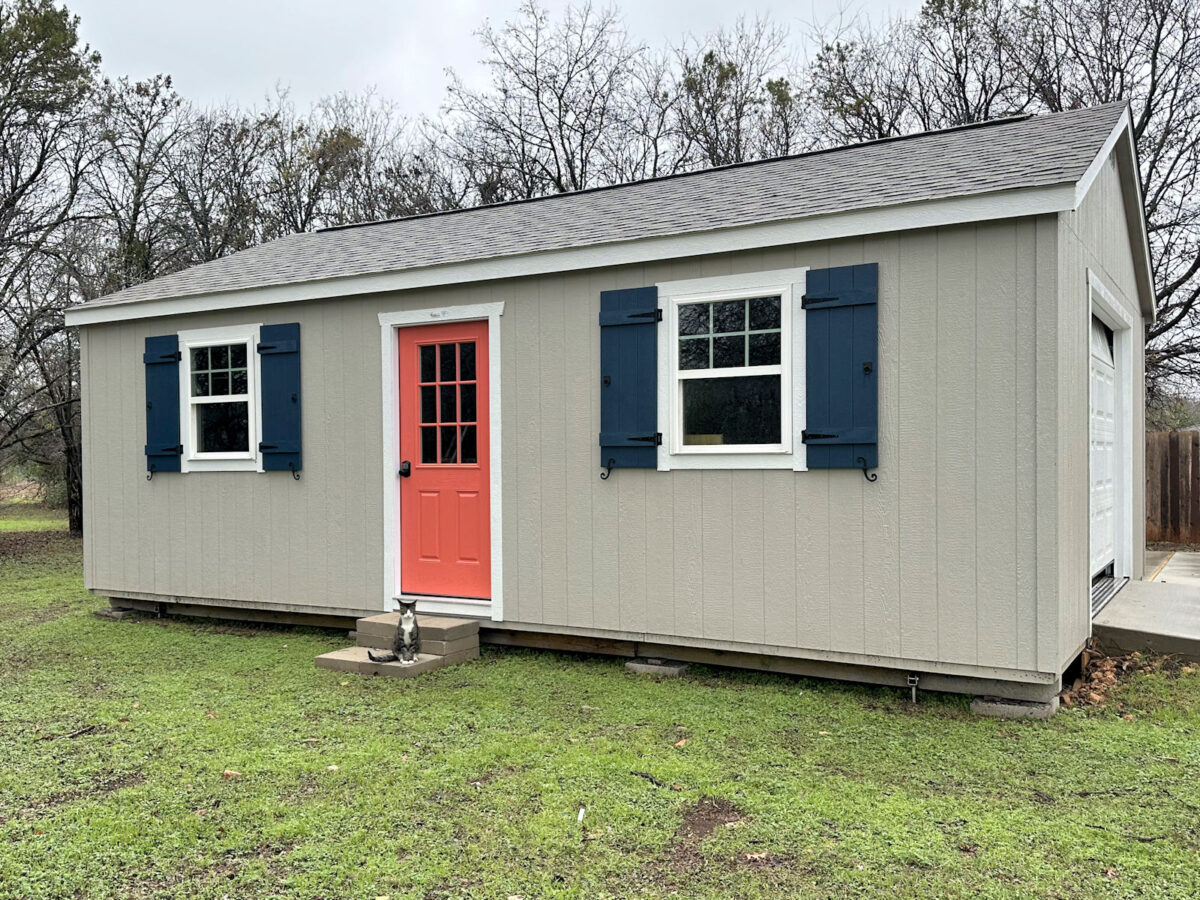
My constructing is constructed on 4 thick wooden skids, which is what the siding is nailed to alongside its backside edge. So the plan was simply to nail the skirting proper to these skids just below the siding.

However I didn’t need the skirting to go behind the steps to the entrance door, which can be my subsequent mission. So earlier than measuring and attaching any skirting, I wished to mark off the width of the steps. I made a decision to make my steps prolong 16 inches from the trim on the door on either side.

After which I measured from the nook of the skid to the mark I simply make. That width on my constructing was 122 inches.

I didn’t need to put the skirting boards proper up towards the siding. I assumed I wanted some form of transition board first. So I minimize lengths of 1″ x 2″ PVC boards, mitered them for the corners of the constructing, and connected them flat (i.e., face up) simply beneath the siding.

*Notice: I can be caulking between this ledger board and the siding utilizing silicone caulk to forestall water from seeping between the 2 and ruining the siding. Since I’m in central Texas, we virtually by no means have a couple of or two days of rain at a time earlier than the Texas solar comes out once more and dries up the rain. So I’m assured that silicone caulk can be sufficient safety from water. If I lived in an space of the nation like Oregon, the place there’s fixed rain for months of the 12 months, I’d have used my desk noticed to chop an angle into the highest of that ledger board to ensure rain water can’t collect there for months on finish. If I discover this flat ledger board to be an issue sooner or later, I can all the time pull it off, minimize an angle in it, and nail it again on. However I don’t suppose it’ll be an issue right here in Texas.
Earlier than I connected that ledger board, I needed to minimize away about 1/4-inch from the underside of one of many nook trim items on the constructing as a result of it was too low and in the best way of the place that ledger board wanted to be connected. I used my Dremel Multi-Max for that.

As soon as that extra was minimize away, the ledger board match completely beneath the siding all the best way to the nook.

I used 2.5-inch 16-gauge nails for this.

Then I used to be prepared to connect the skirting boards. I wished these boards to run horizontally, and it took two boards to fill in that 12-inch top between the bottom and the siding. So I made a decision to connect the boards collectively utilizing PVC glue and pocket screws after which connect them as one piece to the constructing. So I marked and drilled the entire pocket holes, maintaining them to about 12 inches aside.

After which I used a liberal quantity of PVC glue on the perimeters of each boards.

After which screwed them collectively utilizing the pocket holes and Kreg 1.25-inch exterior screws, working as rapidly as potential in order that I might get them screwed collectively earlier than the PVC glue dried.

After I acquired the boards over to the constructing, I noticed that there wasn’t fairly sufficient room on the best finish for the boards to suit into the skirting space. However I didn’t need to minimize the boards.

So as an alternative, I dug out a trench for the boards to suit.

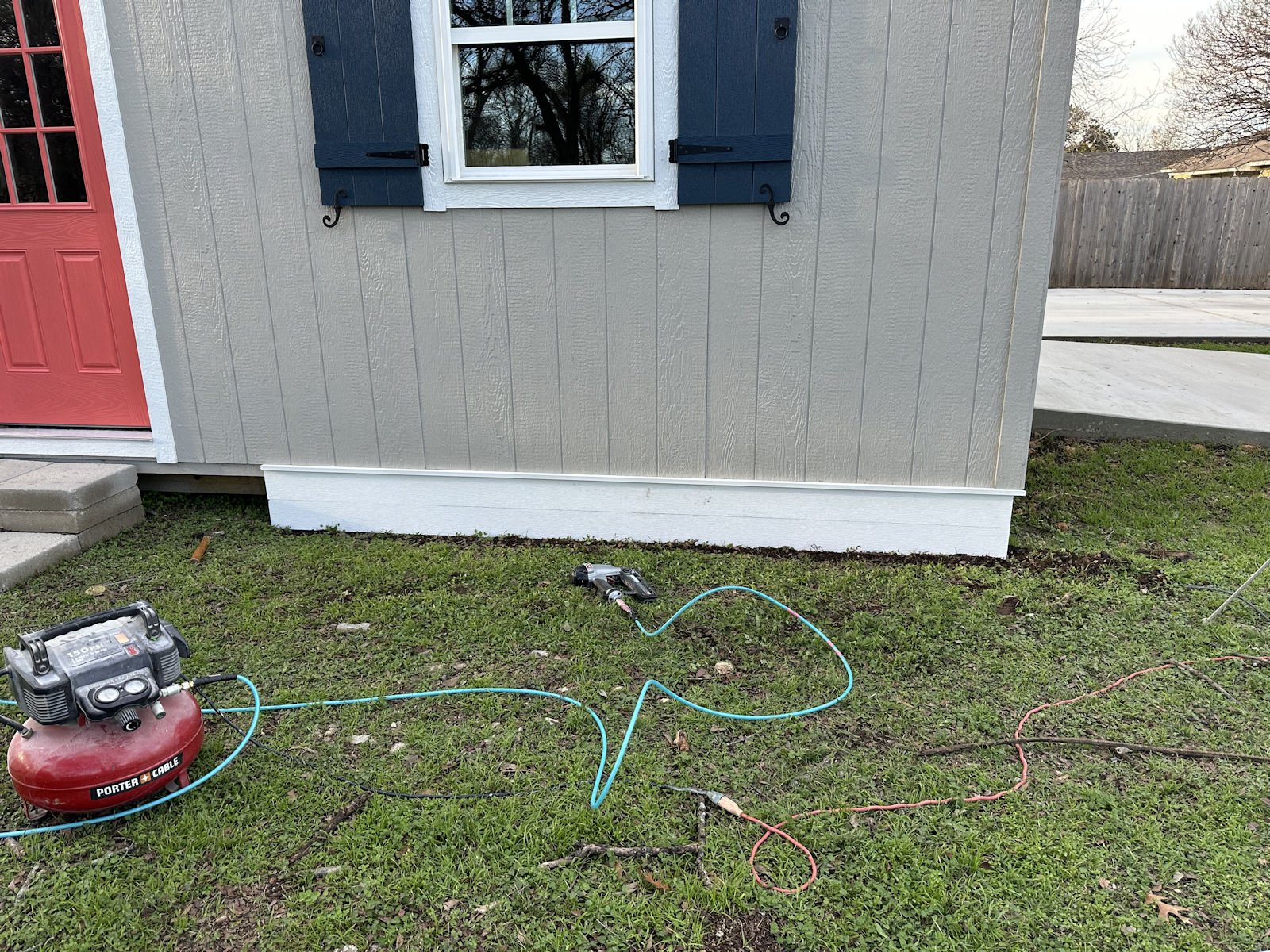
And right here’s what it regarded like when it was connected.

I repeated that complete course of for the opposite facet of the entrance door, and right here’s what the workshop regarded like with either side of the skirting connected on the entrance of the constructing.

I made a decision to do the again of the constructing subsequent as a result of I knew this one was going to be the most important problem, and I wished to get it over with. This facet is an uninterrupted 27-foot run of skirting. So I began by attaching the transition ledger board.

The longest PVC 1″ x 2″ boards solely are available in 12-foot lengths, so I needed to have two joints on this facet. I minimize the top of the primary board at a 45-degree angle…

After which minimize the subsequent board at that very same angle…

That helps to disguise the joint far more than if the boards had straight cuts.

Subsequent up was the skirting. This was probably the most difficult a part of the day as a result of I needed to pre-assemble a 27-foot run of skirting. I made a decision to stagger the boards, just like how you put in hardwood flooring, in order that I didn’t have joints within the high row lining up with joints within the backside row. I couldn’t get an image of the entire 27-foot run of skirting, however you possibly can see within the picture under how the joint between two boards within the backside row is towards a strong board on the highest row.

I marked and drilled the pocket holes in the entire boards first, after which assembled them on the driveway. Probably the most difficult half was working rapidly sufficient with the PVC glue to get the boards collectively earlier than the glue began to dry.

And as soon as it was all collectively, I had to determine find out how to drag that 27-foot size of PVC board skirting over to the constructing. PVC boards are very flexible, not like actual wooden. And I didn’t need to drag it on the concrete face down as a result of it could scratch up the face of the boards. So I lastly realized that I might use the furnishings dolly on one finish after which choose up the opposite finish and pull it over to the constructing.

By the point I acquired it to the constructing and lined up, not solely was I fully out of daylight, however I additionally realized that this complete 27-foot size goes to wish trenching for the skirting to suit.

So it undoubtedly wasn’t a one-day mission. I didn’t understand how a lot digging and trenching could be obligatory, after which simply making an attempt to determine how to try this future of skirting on the again of the constructing took approach longer than I assumed it could. Nevertheless it’s an excellent begin, and I believe the white skirting seems so good on the constructing! So, hopefully it’ll solely take yet one more day, however I’ve a sense it could be two or three. I suppose it depends upon how a lot trenching is required, and the way lengthy that takes.

Addicted 2 Adorning is the place I share my DIY and adorning journey as I rework and beautify the 1948 fixer higher that my husband, Matt, and I purchased in 2013. Matt has M.S. and is unable to do bodily work, so I do nearly all of the work on the home on my own. You can learn more about me here.
Trending Merchandise







![Rustic Grey Mason Jar Sconces for Home Decor, Decorative Chic Hanging Wall Decor Mason Jars with LED Strip Lights, 6-Hour Timer, Silk Hydrangea, & Iron Hooks for Home & Kitchen Decorations [Set of 2]](https://m.media-amazon.com/images/I/41DPf4UgGOL._SS300_.jpg)
