
Within the third episode of “Artistic Dialogues,” an interview collection produced by the filmmaking division of generative AI startup Runway, multimedia artist Claire Hentschker expresses a concern that AI will commoditize the creative course of to the purpose the place artwork homogenizes, regressing to a kind of spinoff sameness.
“Are you getting this more and more narrower common of present issues?” she asks. “After which — as that retains getting averaged — is every part is simply gonna be a blob?”
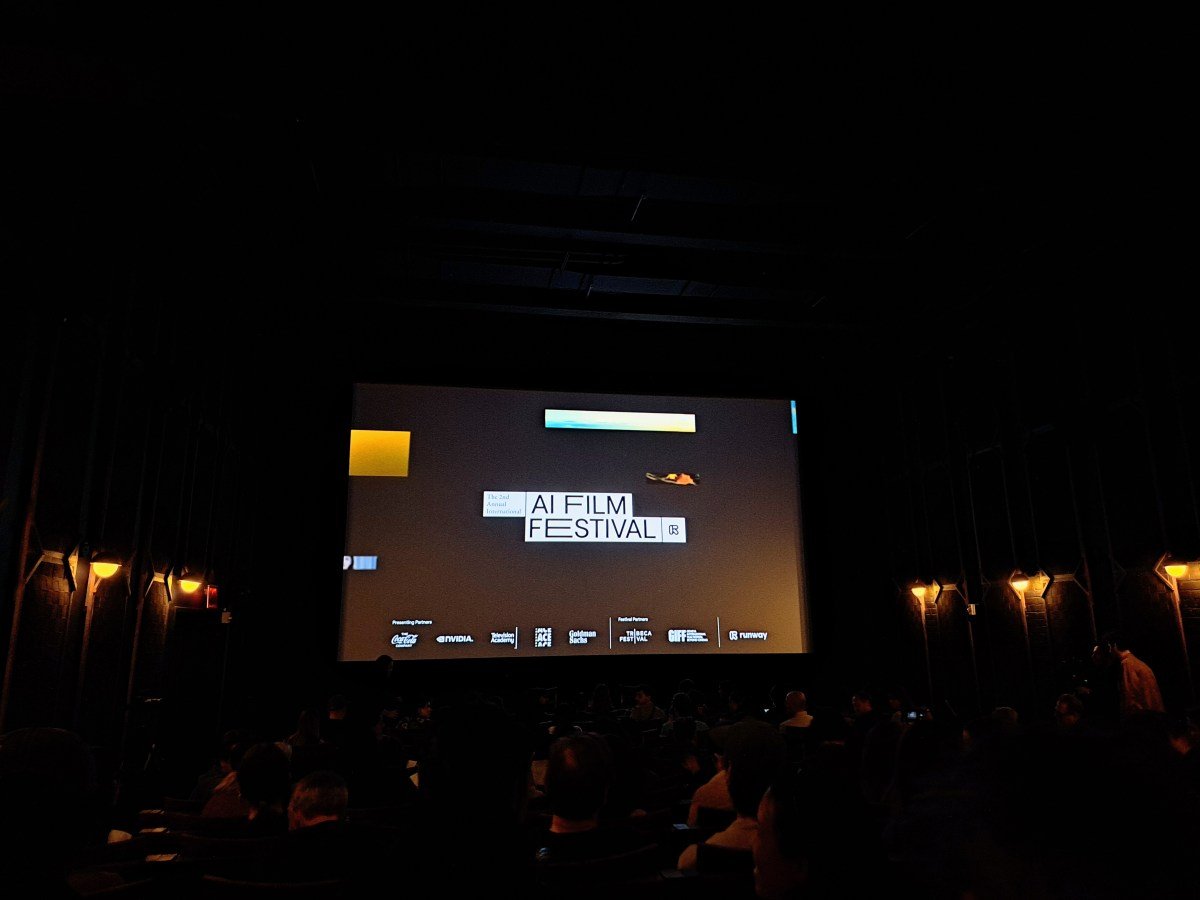
These are the questions I saved asking myself Wednesday at a exhibiting of the highest 10 finalists at Runway’s second annual AI Movie Competition, that are available on-demand on Runway’s web site as of this morning.
Runway held two premieres this 12 months, one in Los Angeles and a second in New York. I attended New York’s, which befell at Metrograph, a theater recognized for its arthouse and avant-garde bookings.

I’m happy to report that AI isn’t hastening in a blob future … not but at the least. However a talented directorial eye — the human contact — makes a transparent distinction in an “AI movie’s” effectiveness.
The entire films submitted to the pageant integrated AI in some kind, together with AI-generated backdrops and animations, artificial voice-overs, and bullet time-style particular results. Not one of the components appeared fairly to the extent of what state-of-the-art instruments like OpenAI’s Sora can produce, however that was to be anticipated, provided that many of the submissions have been finalized early within the 12 months.
Certainly, it tended to be apparent — generally painfully so — which components of movies have been the product of an AI mannequin, not an actor, cameraman or animator. Even in any other case sturdy scripts have been generally let down by underwhelming generative AI results.
Take, for instance, “Expensive Mother” by Johans Saldana Guadalupe and Katie Luo, which recounts the story of a daughter’s loving relationship together with her mom — within the daughter’s personal phrases. It’s a tearjerker. However a scene of a Los Angeles freeway with all of the telltale weirdness of AI-generated video (e.g., warped vehicles, weird physics) broke the spell for me.

The constraints of at present’s AI instruments appeared to field some movies in.
As my colleague Devin Coldewey recently wrote, management with generative fashions — notably video-generating ones — is elusive. Easy issues in conventional filmmaking, like selecting a shade in a personality’s clothes, require workarounds as a result of every shot is created independently of the others. Typically not even workarounds do the trick.
The ensuing disjointedness was on show on the pageant, the place a number of of the movies have been little greater than tangentially associated vignettes strung collectively by narration and a soundtrack. “L’éveil à la création” by Carlo De Togni and Elena Sparacino demonstrated simply how boring this formulation might be, with slideshow-like transitions that will make for a greater interactive storybook than movie.
Léo Cannone’s “The place Do Grandmas Go When They Get Misplaced?” falls into the vignettes class as effectively — however triumphs regardless of this due to a heartfelt script (a baby describing what occurs to grandmothers after they move) and an exceptionally sturdy efficiency from its baby star. The remainder of the viewers appeared to agree; the movie obtained one of many extra spirited rounds of applause of the night time.

And for me, that basically sums up the pageant in a nutshell. The human — not AI — contributions usually make all of the distinction. The emotionality in a baby actor’s voice? That sticks with you. AI-generated backdrops? Much less so.
This was actually true for pageant Grand Prix winner “Get Me Out,” which paperwork one Japanese man’s wrestle to recuperate from the psychological toll of his immigration to the U.S. as a younger baby. Filmmaker Daniel Antebi depicts the person’s panic assaults with the assistance of AI-generated graphics — graphics that I discovered to be much less profitable, finally, than the cinematography. The movie ends with a shot of the person strolling up a bridge simply because the streetlights dotting the pedestrian lane flicker on one after the other. It’s haunting — and delightful — and absolutely took ages to seize simply so.

It’s very doable that generative AI will in the future have the ability to re-create scenes like this. Maybe cinematography will finally get replaced with prompts — a sufferer of the ever-growing datasets (albeit with troubling copyright status) on which startups akin to Runway and OpenAI are coaching their video-generating fashions.
However that day isn’t at present.
Because the screening wrapped up and the award recipients marched to the entrance of the theater for a photograph op, I couldn’t assist however discover the cameraman within the nook documenting the entire affair. Possibly, quite the opposite, AI won’t ever change some issues, just like the humanity we people deeply crave.
Trending Merchandise







![Rustic Grey Mason Jar Sconces for Home Decor, Decorative Chic Hanging Wall Decor Mason Jars with LED Strip Lights, 6-Hour Timer, Silk Hydrangea, & Iron Hooks for Home & Kitchen Decorations [Set of 2]](https://m.media-amazon.com/images/I/41DPf4UgGOL._SS300_.jpg)
