

GitHub’s chief authorized officer, Shelley McKinley, has loads on her plate, what with legal wrangles round its Copilot pair-progammer, in addition to the Synthetic Intelligence (AI) Act, which was voted through the European Parliament this week as “the world’s first complete AI regulation.”
Three years in the making, the EU AI Act first reared its head back in 2021 by way of proposals designed to deal with the rising attain of AI into our on a regular basis lives. The brand new authorized framework is ready to control AI purposes based mostly on their perceived dangers, with completely different guidelines and prerequisites relying on the appliance and use-case.
GitHub, which Microsoft bought for $7.5 billion in 2018, has emerged as one of the vital vocal naysayers round one very particular factor of the laws: muddy wording on how the principles would possibly create authorized legal responsibility for open supply software program builders.
McKinley joined Microsoft in 2005, serving in varied authorized roles together with {hardware} companies equivalent to Xbox and Hololens, in addition to common counsel positions based mostly in Munich and Amsterdam, earlier than touchdown within the Chief Authorized officer hotseat at GitHub arising for 3 years in the past.
“I moved over to GitHub in 2021 to tackle this position, which is a little bit bit completely different to some Chief Authorized Officer roles — that is multidisciplinary,” McKinley informed TechCrunch. “So I’ve received customary authorized issues like business contracts, product, and HR points. After which I’ve accessibility, so [that means] driving our accessibility mission, which implies all builders can use our instruments and providers to create stuff.”
McKinley can also be tasked with overseeing environmental sustainability, which ladders straight as much as Microsoft’s personal sustainability targets. After which there are points associated to belief and security, which covers issues like moderating content material to make sure that “GitHub stays a welcoming, secure, optimistic place for builders,” as McKinley places it.
However there’s no ignoring that the truth that McKinley’s position has turn out to be more and more intertwined with the world of AI.
Forward of the EU AI Act getting the greenlight this week, TechCrunch caught up with McKinley in London.

GitHub Chief Authorized Officer Shelley McKinley Picture Credit: GitHub
Two worlds collide
For the unfamiliar, GitHub is a platform that permits collaborative software program growth, permitting customers to host, handle, and share code “repositories” (a location the place project-specific information are saved) with anybody, anyplace on the earth. Firms pays to make their repositories non-public for inside tasks, however GitHub’s success and scale has been pushed by open supply software program growth carried out collaboratively in a public setting.
Within the six years because the Microsoft acquisition, a lot has modified within the technological panorama. AI wasn’t exactly novel in 2018, and its growing impact was becoming more evident throughout society — however with the appearance of ChatGPT, DALL-E, and the rest, AI has arrived firmly within the mainstream consciousness.
“I’d say that AI is taking on [a lot of] my time — that features issues like ‘how will we develop and ship AI merchandise,’ and ‘how will we interact within the AI discussions which can be occurring from a coverage perspective?,’ in addition to ‘how will we take into consideration AI because it comes onto our platform?’,” McKinley mentioned.
The advance of AI has additionally been closely depending on open supply, with collaboration and shared information pivotal to a few of the most preeminent AI techniques right this moment — that is maybe finest exemplified by the generative AI poster youngster OpenAI, which started with a robust open-source basis earlier than abandoning these roots for a extra proprietary play (this pivot can also be one of many causes Elon Musk is currently suing OpenAI).
As well-meaning as Europe’s incoming AI laws is likely to be, critics argued that they would have significant unintended consequences for the open supply neighborhood, which in flip might hamper the progress of AI. This argument has been central to GitHub’s lobbying efforts.
“Regulators, policymakers, attorneys… will not be technologists,” McKinley mentioned. “And one of the vital vital issues that I’ve personally been concerned with over the previous yr, goes out and serving to to coach individuals on how the merchandise work. Individuals simply want a greater understanding of what’s occurring, in order that they will take into consideration these points and are available to the suitable conclusions when it comes to implement regulation.”
On the coronary heart of the issues was that the laws would create authorized legal responsibility for open supply “common function AI techniques,” that are constructed on fashions able to dealing with a mess of various duties. If open supply AI builders had been to be held chargeable for points arising additional down-stream (i.e. on the utility stage), they is likely to be much less inclined to contribute — and within the course of, extra energy and management can be bestowed upon the large tech companies creating proprietary techniques.
Open supply software program growth by its very nature is distributed, and GitHub — with its 100 million-plus developers globally — wants builders to be incentivized to proceed contributing to what many tout because the fourth industrial revolution. And that is why GitHub has been so vociferous concerning the AI Act, lobbying for exemptions for builders engaged on open supply common function AI expertise.
“GitHub is the house for open supply, we’re the steward of the world’s largest open supply neighborhood,” McKinley mentioned. “We wish to be the house for all builders, we wish to speed up human progress via developer collaboration. And so for us, it’s mission crucial — it’s not only a ‘enjoyable to have’ or ‘good to have’ — it’s core to what we do as an organization as a platform.”
As issues transpired, the textual content of the AI Act now consists of some exemptions for AI fashions and techniques launched beneath free and open-source licenses — although a notable exception consists of the place “unacceptable” high-risk AI techniques are at play. So in impact, builders behind open supply common function AI fashions don’t have to offer the identical stage of documentation and ensures to EU regulators — although it’s not but clear which proprietary and open-source fashions will fall beneath its “high-risk” categorization.
However these intricacies apart, McKinley reckons that their arduous lobbying work has largely paid off, with regulators inserting much less give attention to software program “componentry” (the person parts of a system that open-source builders usually tend to create), and extra on what’s taking place on the compiled utility stage.
“That could be a direct results of the work that we’ve been doing to assist educate policymakers on these subjects,” McKinley mentioned. “What we’ve been in a position to assist individuals perceive is the componentry facet of it — there’s open supply parts being developed on a regular basis, which can be being put out without spending a dime and that [already] have a number of transparency round them — as do the open supply AI fashions. However how will we take into consideration responsibly allocating the legal responsibility? That’s actually not on the upstream builders, it’s simply actually downstream business merchandise. So I feel that’s a extremely large win for innovation, and an enormous win for open supply builders.”
Enter Copilot
With the rollout of its AI-enabled pair-programming tool Copilot three years again, GitHub set the stage for a generative AI revolution that appears set to upend nearly each business, together with software program growth. Copilot suggests traces or capabilities because the software program developer sorts, a little bit like how Gmail’s Smart Compose hurries up e mail writing by suggesting the subsequent chunk of textual content in a message.
Nonetheless, Copilot has upset a considerable phase of the developer neighborhood, together with these on the not-for-profit Software program Freedom Conservancy, who called for all open source software developers to ditch GitHub within the wake of Copilot’s commercial launch in 2022. The issue? Copilot is a proprietary, paid-for service that capitalizes on the arduous work of the open supply neighborhood. Furthermore, Copilot was developed in cahoots with OpenAI (earlier than the ChatGPT craze), leaning substantively on OpenAI Codex, which itself was educated on an enormous quantity of public supply code and pure language fashions.
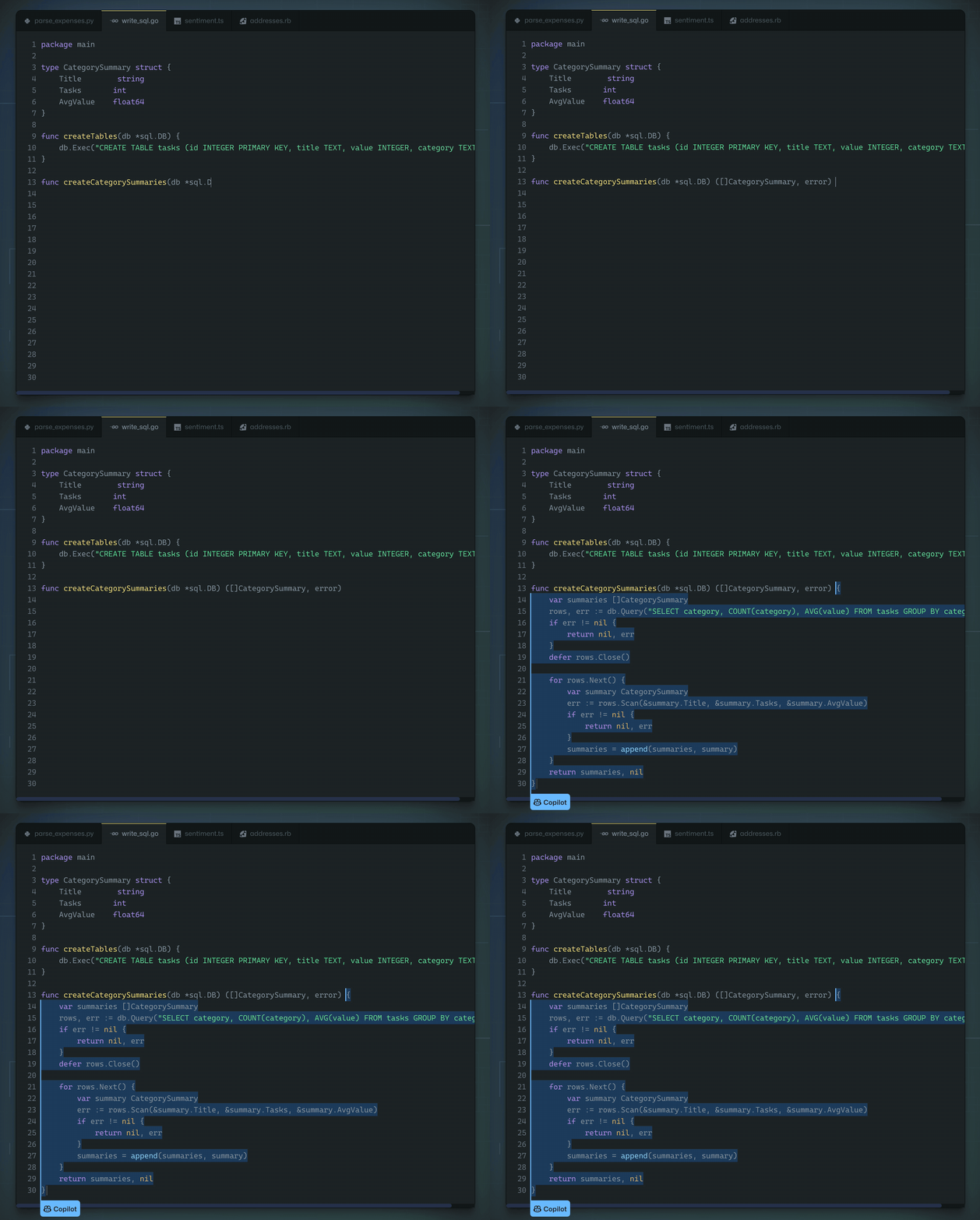
GitHub Copilot Picture Credit: GitHub
Copilot in the end raises key questions round who authored a bit of software program — if it’s merely regurgitating code written by one other developer, then shouldn’t that developer get credit score for it? Software program Freedom Conservancy’s Bradley M. Kuhn wrote a considerable piece exactly on that matter, known as: “If Software is My Copilot, Who Programmed My Software?”
There’s a false impression that “open supply” software program is a free-for-all — that anybody can merely take code produced beneath an open supply license and do as they please with it. However whereas completely different open supply licenses have completely different restrictions, all of them just about have one notable stipulation: builders reappropriating code written by another person want to incorporate the proper attribution. It’s tough to do this in case you don’t know who (if anybody) wrote the code that Copilot is serving you.
The Copilot kerfuffle additionally highlights a few of the difficulties in merely understanding what generative AI is. Massive language fashions, equivalent to these utilized in instruments equivalent to ChatGPT or Copilot, are educated on huge swathes of information — very similar to a human software program developer learns to do one thing by poring over earlier code, Copilot is at all times prone to produce output that’s related (and even an identical) to what has been produced elsewhere. In different phrases, every time it does match public code, the match “continuously” applies to “dozens, if not hundreds” of repositories.
“That is generative AI, it’s not a copy-and-paste machine,” McKinley mentioned. “The one time that Copilot would possibly output code that matches publicly out there code, typically, is that if it’s a really, quite common means of doing one thing. That mentioned, we hear that individuals have issues about this stuff — we’re making an attempt to take a accountable strategy, to make sure that we’re assembly the wants of our neighborhood when it comes to builders [that] are actually enthusiastic about this instrument. However we’re listening to builders suggestions too.”
On the tail finish of 2022, with a number of U.S. software program builders sued the corporate alleging that Copilot violates copyright regulation, calling it “unprecedented open-source tenderware piracy.” Within the intervening months, Microsoft, GitHub, and OpenAI managed to get varied sides of the case thrown out, however the lawsuit rolls on, with the plaintiffs lately submitting an amended criticism round GitHub’s alleged breach-of-contract with its builders.
The authorized skirmish wasn’t precisely a shock, as McKinley notes. “We undoubtedly heard from the neighborhood — all of us noticed the issues that had been on the market, when it comes to issues had been raised,” McKinley mentioned.
With that in thoughts, GitHub made some efforts to allay issues over the way in which Copilot would possibly “borrow” code generated by different builders. For example, it launched a “duplication detection” characteristic. It’s turned off by default, however as soon as activated, Copilot will block code completion recommendations of greater than 150 characters that match publicly out there code. And final August, GitHub debuted a new code-referencing feature (nonetheless in beta), which permits builders to observe the breadcrumbs and see the place a steered code snippet comes from — armed with this data, they will observe the letter of the regulation because it pertains to licensing necessities and attribution, and even use your complete library which the code snippet was appropriated from.
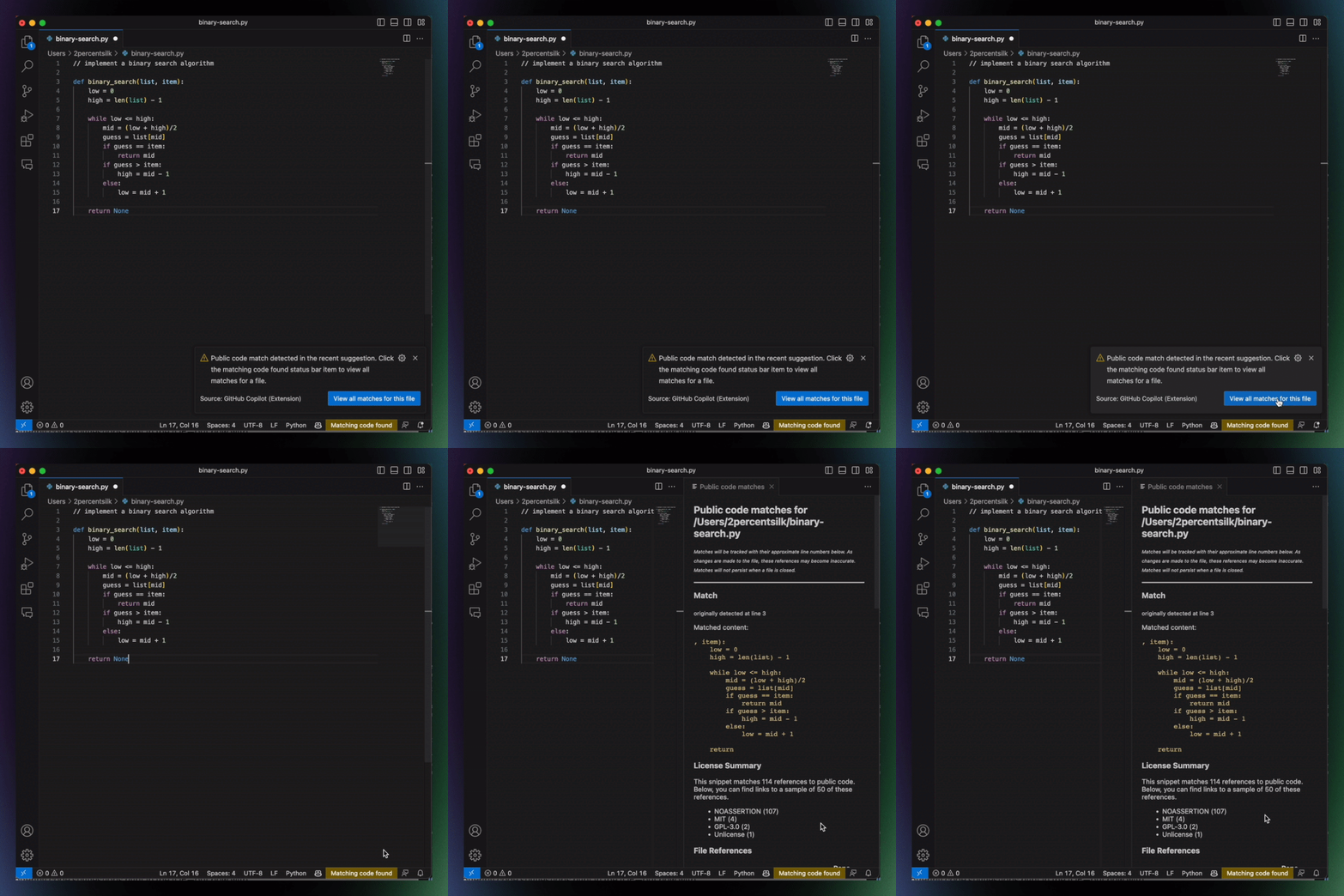
Copilot Code Match Picture Credit: GitHub
But it surely’s tough to evaluate the dimensions of the issue that builders have voiced issues about — GitHub has beforehand mentioned that its duplication detection characteristic would set off “lower than 1%” of the time when activated. Even then, it’s often when there’s a near-empty file with little native context to run with — so in these instances, it’s extra prone to make a suggestion that matches code written elsewhere.
“There are a number of opinions on the market — there are greater than 100 million developers on our platform,” McKinley mentioned. “And there are a number of opinions between all the builders, when it comes to what they’re involved about. So we try to react to suggestions to the neighborhood, proactively take measures that we predict assist make Copilot an important product and expertise for builders.”
What subsequent?
The EU AI Act progressing is only the start — we now know that it’s undoubtedly taking place, and in what kind. However it can nonetheless be at the very least one other couple of years earlier than corporations should adjust to it — just like how corporations needed to put together for GDPR within the information privateness realm.
“I feel [technical] requirements are going to play an enormous position in all of this,” McKinley mentioned. “We’d like to consider how we will get harmonised requirements that corporations can then adjust to. Utilizing GDPR for example, there are all types of various privateness requirements that individuals designed to harmonise that. And we all know that because the AI Act goes to implementation, there will likely be completely different pursuits, all making an attempt to determine implement it. So we wish to be sure that we’re giving a voice to builders and open supply builders in these discussions.”
On prime of that, extra laws are on the horizon. President Biden lately issued an executive order with a view towards setting requirements round AI security and safety, which supplies a glimpse into how Europe and the U.S. would possibly in the end differ because it pertains to regulation — even when they do share the same “risk-based” strategy.
“I’d say the EU AI Act is a ‘elementary rights base,’ as you’d anticipate in Europe,” McKinley mentioned. “And the U.S. aspect could be very cybersecurity, deep-fakes — that type of lens. However in some ways, they arrive collectively to give attention to what are dangerous situations — and I feel taking a risk-based strategy is one thing that we’re in favour of — it’s the suitable means to consider it.”
Trending Merchandise







![Rustic Grey Mason Jar Sconces for Home Decor, Decorative Chic Hanging Wall Decor Mason Jars with LED Strip Lights, 6-Hour Timer, Silk Hydrangea, & Iron Hooks for Home & Kitchen Decorations [Set of 2]](https://m.media-amazon.com/images/I/41DPf4UgGOL._SS300_.jpg)
