
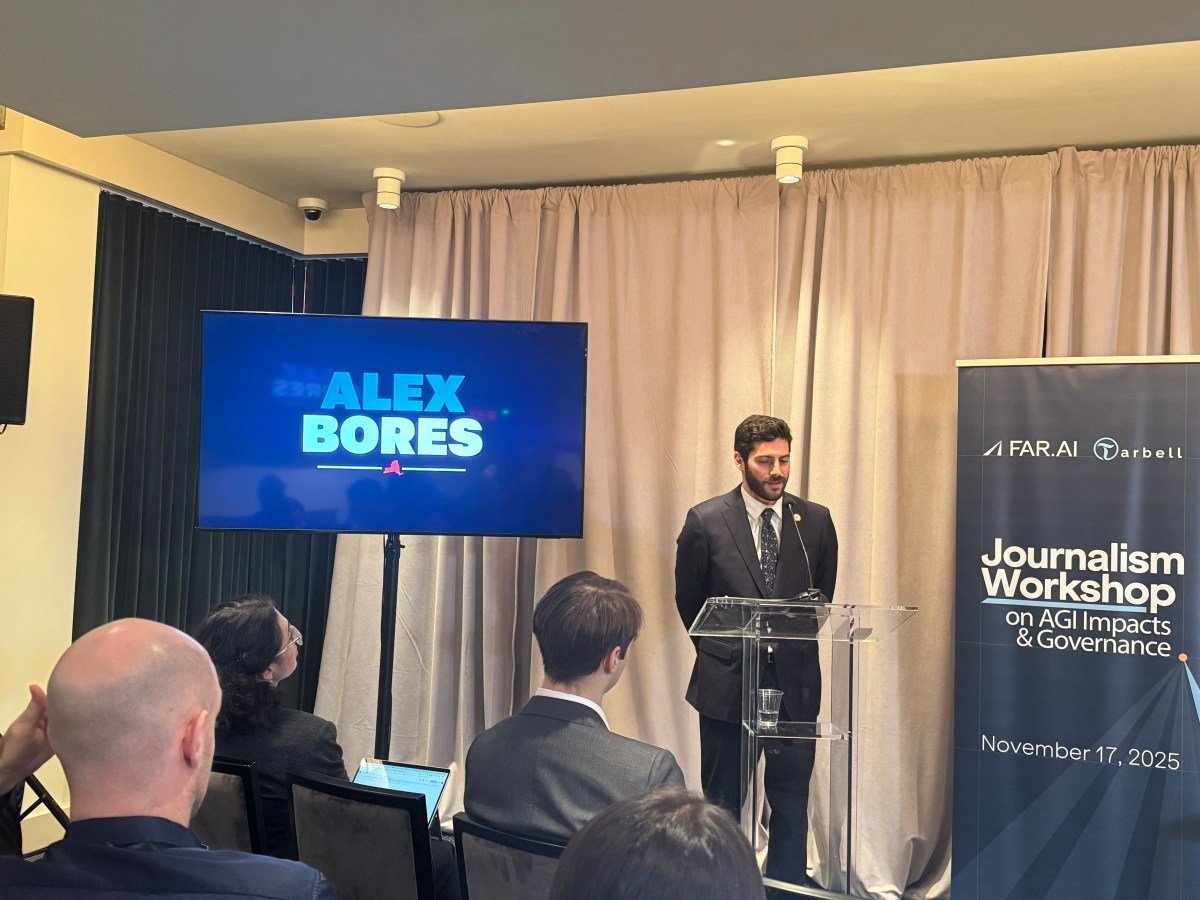
A professional-AI tremendous PAC backed by Andreessen Horowitz and OpenAI President Greg Brockman has chosen New York Meeting member Alex Bores — and his congressional bid — as its first goal.
The PAC, dubbed Leading the Future, fashioned in August with a greater than $100 million dedication to help policymakers with a light-touch — or a no-touch — method to AI regulation. And which means going after policymakers who wish to regulate AI. The tremendous PAC has backing from various different outstanding leaders in tech, together with Palantir co-founder and 8VC managing associate Joe Lonsdale in addition to AI search engine Perplexity.
“I recognize how simple they’re being about it,” Bores advised a room of journalists Monday night at a Journalism Workshop on AGI impacts and governance in Washington, D.C. “After they say, ‘Hey, we’re going to spend tens of millions in opposition to Alex as a result of he may regulate Huge Tech and put primary guardrails on AI,’ I simply mainly ahead that to my constituents.”
Bores, who’s working to symbolize the state’s twelfth Congressional District, mentioned AI anxieties are on the rise amongst his constituents, who fear about every thing from information facilities pushing up utility payments and worsening local weather change to chatbots impacting youngsters’ psychological well being and automation reworking the job market.
Bores is the chief sponsor of New York’s bipartisan RAISE Act, which requires massive AI labs to have a security plan in place to stop crucial harms, observe their very own security plan, and disclose crucial security incidents, like dangerous actors stealing an AI mannequin. The invoice additionally prohibits AI companies from releasing fashions with unreasonable dangers of crucial hurt and imposes civil penalties of as much as $30 million if corporations fail to stay as much as these requirements. The laws is at the moment awaiting Gov. Kathy Hochul’s signature.
Bores mentioned whereas drafting and redrafting the invoice, he consulted with the big AI companies like OpenAI and Anthropic. These negotiations led to the removing of provisions like third-party security audits, which he says the business refused to simply accept. Nonetheless, the RAISE Act, and Bores himself, seems to have incurred the ire of Silicon Valley.
Zac Moffatt and Josh Vlasto, heads of Main the Future, advised Politico that they’d work on a multibillion-dollar effort to sink Bores’ marketing campaign.
Techcrunch occasion
San Francisco
|
October 13-15, 2026
In a press release despatched to TechCrunch, they accused Bores of advancing “ideological and politically motivated laws that will handcuff not solely New York’s, however your complete nation’s capacity to guide on AI jobs and innovation.” The pair mentioned “payments just like the RAISE Act threaten American competitiveness, restrict financial development, depart customers uncovered to international affect and manipulation, and undermine our nationwide safety.”
“The RAISE Act is a transparent instance of the patchwork, uninformed, and bureaucratic state legal guidelines that will gradual American progress and open the door for China to win the worldwide race for AI management,” Moffatt and Vlasto mentioned within the emailed assertion. “America wants one clear and constant nationwide regulatory framework for AI that strengthens our financial system, creates jobs for American employees, helps vibrant communities, and protects customers.”
Many in Silicon Valley have pushed to ban states from passing regulation that pertains to AI. Earlier this yr, a provision blocking state AI legal guidelines was slipped into the federal finances invoice and was later eliminated. Now, lawmakers like Sen. Ted Cruz are looking for to resurrect it via other legislative avenues.
Bores mentioned he’s involved such a motion might proceed to realize legs at a time when the federal authorities has handed no significant AI regulation. The place federal authorities strikes gradual, states are like startups — they’ll operate as coverage laboratories and transfer quick to check what works.
“The query needs to be, has Congress solved the issue?” Bores mentioned. “If Congress solves the issue, then it will probably inform the states to get out of the best way, but when they’re not going to move a invoice that’s truly addressing any of the issues…after which [saying that states can’t do anything] that simply doesn’t make sense to me.”
Bores additionally famous he has been involved with policymakers in different states to work on standardizing laws, which might fight Silicon Valley’s “patchwork” objection. He additionally believes that lawmakers ought to guarantee there aren’t any redundancies with the EU AI Act.
Bores emphasised that AI regulation isn’t meant to restrict innovation, and that he has rejected payments that he thinks would have unintended penalties for the business.
“Having primary guidelines of the highway, literal or metaphorical, is definitely a really pro-innovation stance if achieved properly,” Bores mentioned. “I essentially consider that the AI that wins goes to be the AI that’s reliable. And the pushback from business to say that authorities has no position in establishing that belief is one which I feel you’re seeing individuals reject at each stage.”
Trending Merchandise







![Rustic Grey Mason Jar Sconces for Home Decor, Decorative Chic Hanging Wall Decor Mason Jars with LED Strip Lights, 6-Hour Timer, Silk Hydrangea, & Iron Hooks for Home & Kitchen Decorations [Set of 2]](https://m.media-amazon.com/images/I/41DPf4UgGOL._SS300_.jpg)
