
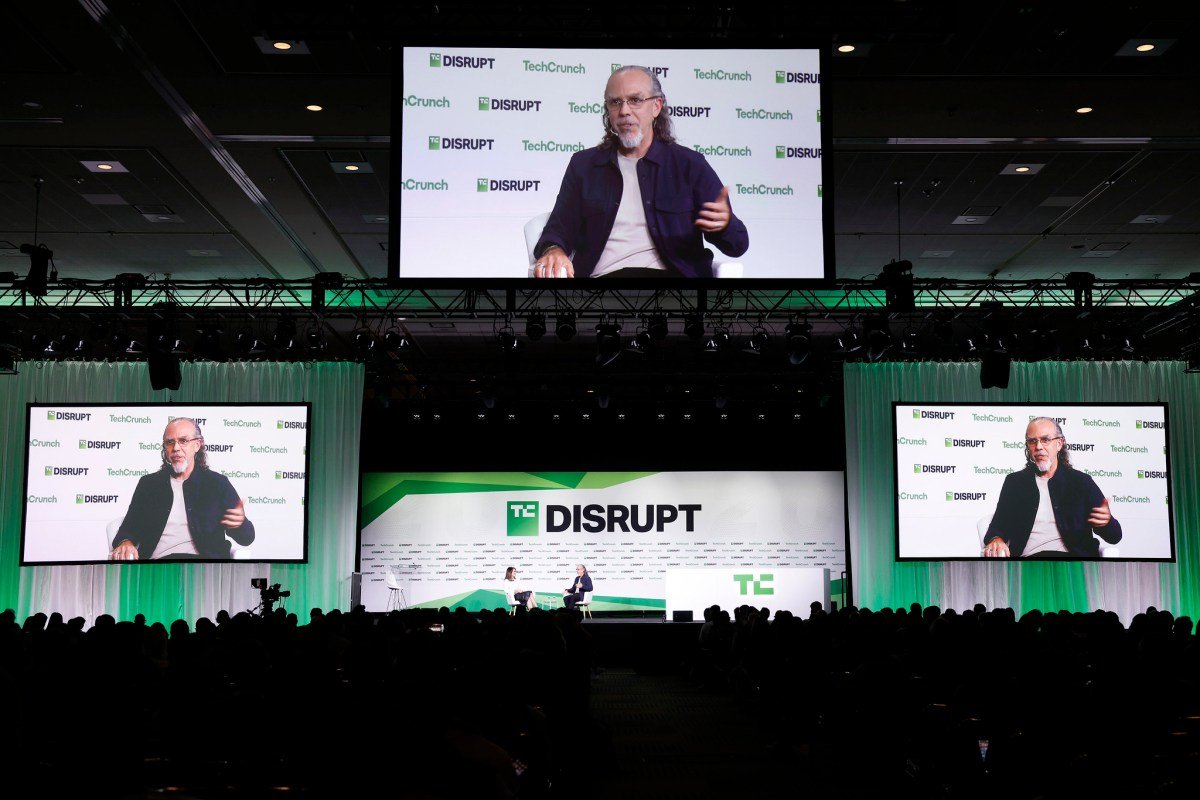
Alphabet’s X moonshot manufacturing facility is shifting the way it brings formidable expertise tasks to market, more and more spinning them out as impartial corporations slightly than preserving them throughout the Alphabet company construction, X’s head honcho, Astro Teller, revealed at TechCrunch Disrupt this previous week.
The technique hinges on a devoted enterprise fund that exists solely to spend money on X spinouts, and during which Alphabet is just a minority investor. “If Alphabet was the only LP, the fund could be within Alphabet, after which once they invested in one thing from X, it will nonetheless be inside Alphabet,” Teller defined onstage. “So Alphabet generally is a small LP, but when it’s greater than a small LP, we undo the factor that we’re attempting to perform.”
That fund is Series X Capital, which has raised over $500 million and is run by Gideon Yu, a former YouTube government and Fb CFO. Bloomberg first reported the fund’s existence last year. In contrast to Alphabet’s different funding arms — GV, which invests broadly in early-stage startups; CapitalG, which backs growth-stage corporations; and Gradient Ventures, which invests in AI startups — Sequence X Capital is legally obligated to take a position solely in corporations spinning out of X.
The strategy represents a significant evolution for X, which has traditionally graduated profitable tasks like Waymo and Wing into standalone Alphabet subsidiaries. Teller mentioned the lab has discovered over the previous decade that whereas some moonshots profit from Alphabet’s sources and scale, others “can go sooner and received’t actually profit from being a part of Alphabet as a result of they’re simply so completely different.”
“Touchdown it simply exterior the Alphabet membrane, the place we might be very tight with them, get a variety of strategic co-benefit with them, however not essentially management them, is sensible,” he mentioned.
At Disrupt, Teller defined that the spinout technique solely works due to X’s ruthless strategy to mental honesty, together with a tradition that actively celebrates killing off promising concepts.
X defines a moonshot as having three particular elements: it should try to unravel an enormous downside on this planet, suggest some form of services or products that would make that downside disappear, and leverage breakthrough tech that creates a “glimmer of hope” that the staff inside X can clear up that downside. Critically, Teller mentioned, “if somebody is proposing a moonshot and it sounds affordable, the corporate isn’t , as a result of that, by definition, wouldn’t be a moonshot.”
What occurs to concepts that meet these standards? X checks them ruthlessly, in search of causes to kill them, Teller mentioned. “Should you suggest one thing and it sounds fairly wild, that has these three elements, and it’s a testable speculation, for a small sum of money, we are able to be taught one thing about whether or not it’s just a little bit extra loopy than we thought, or just a little bit much less loopy than we thought,” Teller defined. “If it’s just a little bit extra loopy than we thought, cool, excessive 5, let’s put a bullet in its head and transfer on.”
Techcrunch occasion
San Francisco
|
October 13-15, 2026
This strategy requires detaching folks from their concepts, which is why Teller mentioned he doesn’t even know who began most tasks at X, together with Waymo, the self-driving automotive firm, and Wing, the drone supply firm now dropping off Walmart packages in roughly six U.S. cities. “If we’re going to go exploring one thing, and also you [as the lead inventor] really feel like ‘that is my child,’ what are the probabilities I get you to follow actual mental honesty?” he advised the Disrupt viewers.
In follow, this implies X tackles the toughest components of tasks first, actively in search of causes to close them down. The result’s a brutal 2% hit fee that Teller frames not as failure however as characteristic. X has killed off way more tasks than it has launched, together with total classes that when appeared promising, like copywriting AI instruments that basis fashions ultimately absorbed.
All that testing and failing might be costly. The spinout construction solves a sensible downside: whereas X beforehand needed to discover exterior enterprise traders prepared to take over a minimum of 51% of a enterprise to spin it out of Alphabet, by making a fund that “deeply understands us” and is “legally obligated solely to spend money on issues that come from us,” mentioned Teller, X can systematize the spinout course of whereas sustaining shut strategic ties.
Regardless of the emphasis on detachment from concepts, X staff do have important pores and skin within the sport when tasks spin out. For these engaged on tasks headed for independence, the monetary incentive is substantial. “You and the remainder of your staff are going to get a bit of that firm,” Teller mentioned. “It’s about as a lot as you’ll have gotten should you had began out of your storage at that stage of funding, however with out taking any danger within the meantime.”
The pitch to potential X staff is specific about this trade-off too. “Your 4 or 5 customary deviation upside goes to be larger on the skin, I’m granting you that,” Teller mentioned at Disrupt. “However should you come to X, what you get to do is be a card counter of innovation with us, with no worry and no monetary danger to your self.”
X staff are paid like different Google staff, with no fairness in early-stage tasks, as a result of “it isn’t even an organization; it’s an concept we’re attempting to study,” Teller defined. This removes the monetary strain that forestalls founders from killing their very own concepts. “You’ll be able to say, ‘Hey, this one’s not pulling our common up, let’s throw this one away,’” Teller defined. “And since you haven’t guess your children’ school fund on that, that doesn’t scare you.”
X has spun out a minimum of two corporations in 2025: Taara, which develops wi-fi optical communication expertise, and Heritable Agriculture, a biotech firm utilizing machine studying to speed up crop breeding. Earlier spinouts that raised exterior funding embrace Malta (renewable vitality storage), Dandelion (geothermal heating), and iyO (AI-powered earbuds).
On the eve of Disrupt, X introduced its latest moonshot firm: Anori, a “new AI platform to assist actual property builders, the structure and building industries, and cities untangle the complexities of latest constructing tasks,” because it describes itself. Requested onstage about what makes this specific AI platform a “moonshot,” Teller pointed to the scale of the issue — and alternative.
“The constructed atmosphere is about 25% of the world’s stable waste, [and] about 25% of the world’s [carbon dioxide] output. It’s actually on the Maslow’s hierarchy of wants — it’s the place we reside, the place we spend most of our time. It’s a giant chunk of the world’s GDP output. So it will be laborious for it to matter extra as an trade.”
You’ll be able to catch our total dialog with Teller here, starting on the 6:08 minute mark.
Trending Merchandise







![Rustic Grey Mason Jar Sconces for Home Decor, Decorative Chic Hanging Wall Decor Mason Jars with LED Strip Lights, 6-Hour Timer, Silk Hydrangea, & Iron Hooks for Home & Kitchen Decorations [Set of 2]](https://m.media-amazon.com/images/I/41DPf4UgGOL._SS300_.jpg)
