
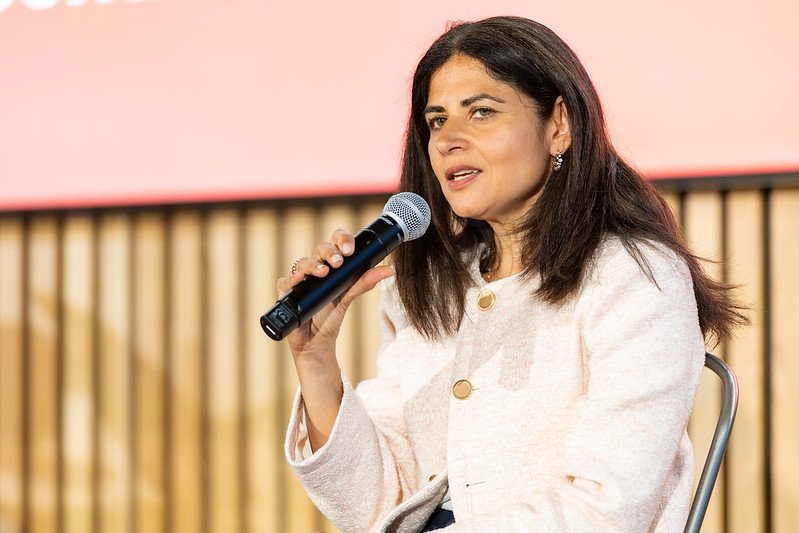
Sonali De Rycker, a normal accomplice at Accel and one in all Europe’s most influential enterprise capitalists, is bullish in regards to the continent’s prospects in AI. However she’s cautious of regulatory overreach that would hamstring its momentum.
At a TechCrunch StrictlyVC night earlier this week in London, De Rycker mirrored on Europe’s place within the international AI race, balancing optimism with realism. “We’ve all of the items,” she advised these gathered for the occasion. “We’ve the entrepreneurs, we’ve the ambition, we’ve the faculties, we’ve the capital, and we’ve the expertise.” All that’s lacking, she argued, is the flexibility to “unleash” that potential at scale.
The impediment? Europe’s advanced regulatory panorama and, partially, its pioneering however controversial Synthetic Intelligence Act.
De Rycker acknowledged that laws have a task to play, particularly in high-risk sectors like healthcare and finance. Nonetheless, she stated she worries that the AI Act’s broad attain and probably stifling fines might deter innovation on the very second European startups want house to iterate and develop.
“There’s an actual alternative to be sure that we go quick and tackle what we’re able to,” she stated. “The difficulty is that we’re additionally confronted with headwinds on regulation.”
The AI Act, which imposes stringent guidelines on functions deemed “excessive threat,” from credit score scoring to medical imaging, has raised crimson flags amongst traders like De Rycker. Whereas the objectives of moral AI and client safety are laudable, she fears the online could also be solid too vast, probably discouraging early-stage experimentation and entrepreneurship.
That urgency is amplified by shifting geopolitics. With U.S. help for Europe’s protection and financial autonomy waning underneath the present Trump administration, De Rycker sees this second as a decisive one for the EU.
“Now that Europe is being left to fend [for itself] in a number of methods,” she stated, “we must be self-sufficient, we must be sovereign.”

Which means unlocking Europe’s full potential. De Rycker factors to efforts just like the “twenty eighth regime,” a framework geared toward making a single algorithm for companies throughout the EU, as essential to making a extra unified, startup-friendly area. At present, the mishmash of labor legal guidelines, licensing, and company constructions throughout the international locations creates friction and slows down progress.
“If we have been really one area, the facility you would unleash can be unbelievable,” she stated. “We wouldn’t be having these similar conversations about Europe lagging in tech.”
In De Rycker’s view, Europe is slowly catching up, not simply in innovation however in its embrace of threat and experimentation. Cities like Zurich, Munich, Paris, and London are beginning to generate their very own self-reinforcing ecosystems because of top-tier tutorial establishments and a rising base of skilled founders.
Accel, for its half, has invested in over 70 cities throughout Europe and Israel, giving De Rycker a front-row seat to the continent’s fragmented however flourishing tech panorama. Nonetheless, on Tuesday evening, she famous a stark distinction with the U.S. in the case of adoption. “We see much more propensity for purchasers to experiment with AI within the U.S.,” she stated. “They’re spending cash on these sorts of speculative, early-stage corporations. That flywheel retains going.”
Accel’s technique displays this actuality. Whereas the agency hasn’t backed any of the key foundational AI mannequin corporations like OpenAI or Anthropic, it has targeted as an alternative on the applying layer. “We really feel very comfy with the applying layer,” stated De Rycker. “These foundational fashions are capital intensive and don’t actually appear to be venture-backed corporations.”

Examples of promising bets embody Synthesia, a video technology platform utilized in enterprise coaching, and Converse, a language studying app that not too long ago jumped to a $1 billion valuation. De Rycker (who dodged questions on Accel’s reported talks with another big name in AI), sees these as early examples of how AI can create solely new behaviors and enterprise fashions.
“We’re increasing complete addressable markets at a price we’ve by no means seen,” she stated. “It feels just like the early days of cell. DoorDash and Uber weren’t simply mobilized web sites. They have been model new paradigms.”
Finally, De Rycker sees this second as each a problem and a once-in-a-generation alternative. If Europe leans too closely into regulation, it dangers stifling the innovation that would assist it compete globally – not simply in AI, however throughout all the tech spectrum.
“We’re in a supercycle,” she stated. “These cycles don’t come typically, and we are able to’t afford to be leashed.”
With geopolitical uncertainty rising and the U.S. more and more wanting inward, Europe has little alternative however to guess on itself. If it could actually strike the precise stability, De Rycker believes it has the whole lot it wants to guide.
Requested by an attendee what EU founders can do to be extra aggressive with their U.S. counterparts, she didn’t hesitate. “I believe they’re [competitive],” she stated, citing corporations Accel has backed, together with Supercell and Spotify. “These founders, they appear no totally different.”
You may catch catch the total dialog with De Rycker right here :
Trending Merchandise







![Rustic Grey Mason Jar Sconces for Home Decor, Decorative Chic Hanging Wall Decor Mason Jars with LED Strip Lights, 6-Hour Timer, Silk Hydrangea, & Iron Hooks for Home & Kitchen Decorations [Set of 2]](https://m.media-amazon.com/images/I/41DPf4UgGOL._SS300_.jpg)
